
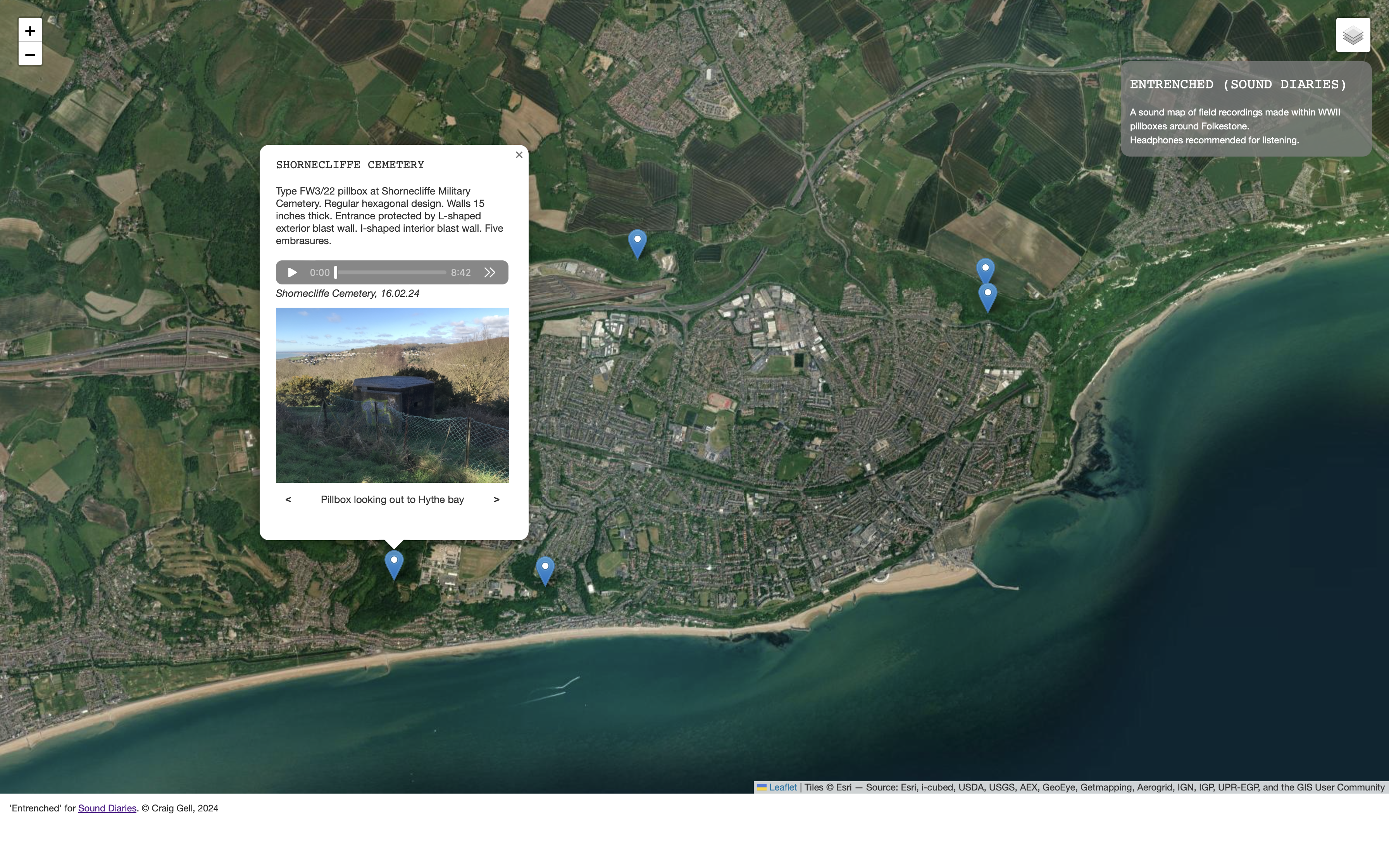
My project for Sound Diaries is a sound map of field recordings made inside extant WWII pillbox defences surrounding my hometown of Folkestone, Kent.
These reinforced concrete chambers, commissioned in 1940 to defend Britain against invasion, remain embedded in the landscape, in fields, lanes and hedgerows, obsolete but still sentinel — watching and listening as the world around them moves on.
The pillboxes are designed to resist ‘enemy’ gunfire and safely cocoon those garrisoned within. A small amount of light and sound is able to penetrate through their narrow entrances and embrasures. Inside they are acoustically highly reflective, and sound is transformed by the structural properties of the space.
The Project
The recordings aim to capture the exterior soundscape from within — using the pillboxes as a ‘sound box’ to explore the effects of variation in their structural design on incoming sound, and as a ‘listening post’ to document the contemporary acoustic environment from its long-held militaristic vantage point. The listener can experience the unique auditory perspective, character and sensory effects of each space.
The web-based sound map combines my documentation with open-source map data enabling listeners to explore the wider landscape, through satellite imagery and topographic detail, to supplement their experience of each recording.
My starting point for this project was a recording I made in 2021 at a pillbox situated on Cherry Garden Hill. Interestingly, the pillbox has been dug into a Bronze Age barrow and together they are a designated Scheduled Monument due to their cultural and historic importance. From its vantage point along the ridge of the Folkestone Downs, the distant rumblings of the Channel Tunnel complex can be heard and felt from below.
The Pillboxes
The sites surveyed for this project form part of the defence grouping known as the ‘Folkestone Nodal Point’. Their design falls into two variants: the Type 22 – regular hexagonal plan (a), and Type 24 – irregular hexagonal plan (b). Each typically has up to five embrasures, and an interior blast wall (Y-shaped in these diagrams). The interior room height is usually around 2 metres, with 3 metres between opposite walls. Walls vary in thickness from between 12” and 24”. A further ‘Shellproof’ designation is given to pillboxes with up to twice the wall thickness.

A hexagon has rotational symmetry and architectural strength. The three-dimensional space of a Type 22 pillbox can be described as a hexagonal prism, and its interior volume roughly calculated.

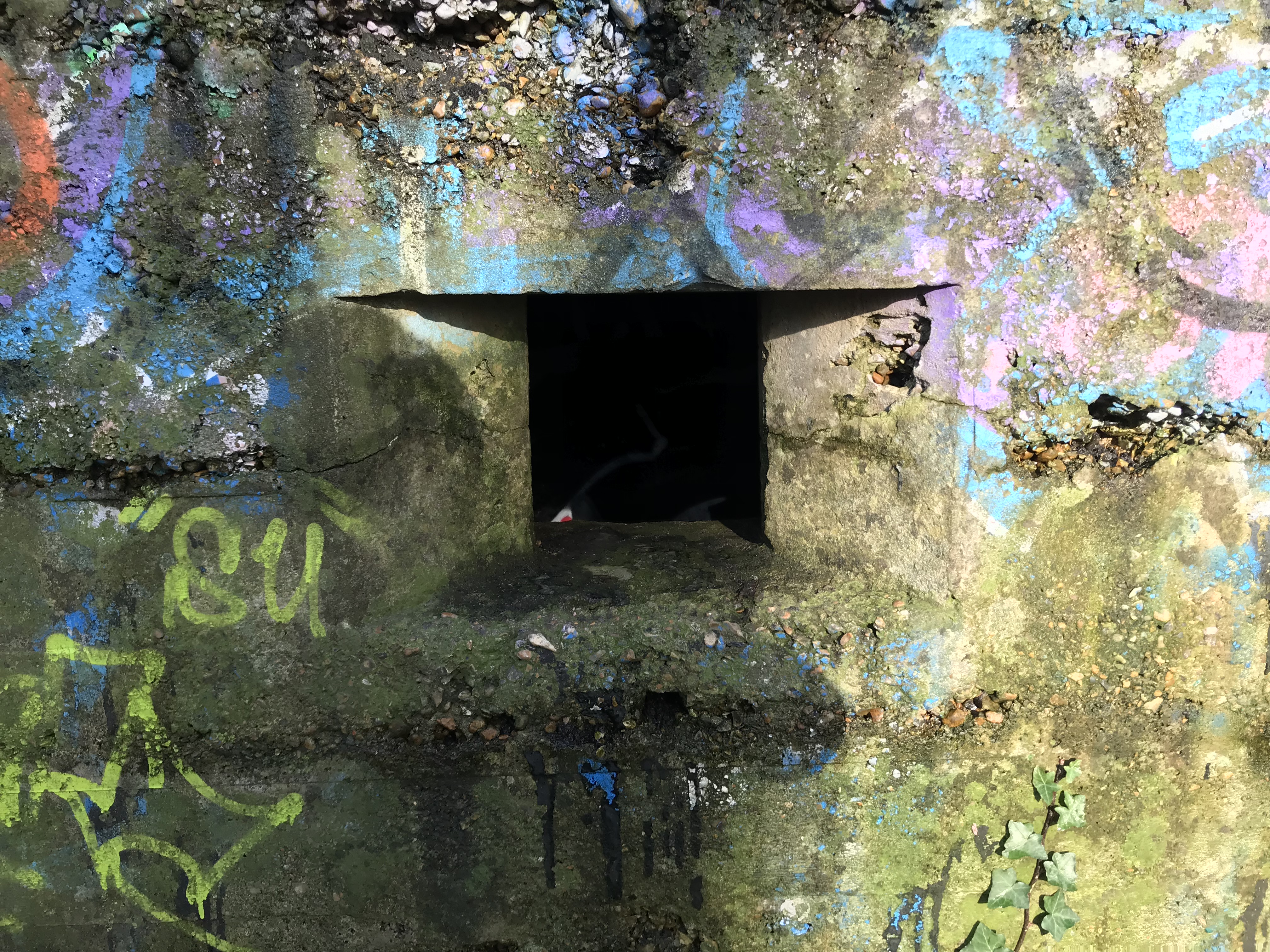
Typically each pillbox has an embrasure, gun- or loophole (with an aperture of 10”x 8”) within each side wall barring the entrance wall. There is some variation in their exterior finish having either a smooth splayed opening, or a stepped ‘anti-ricochet’ design which may act to ‘baffle’ the passage of sound. It is common to find one or more embrasures have been bricked-up. In Type 24 pillboxes where an exterior blast wall is covering the entrance, it is common for one or both embrasures to be filled in.
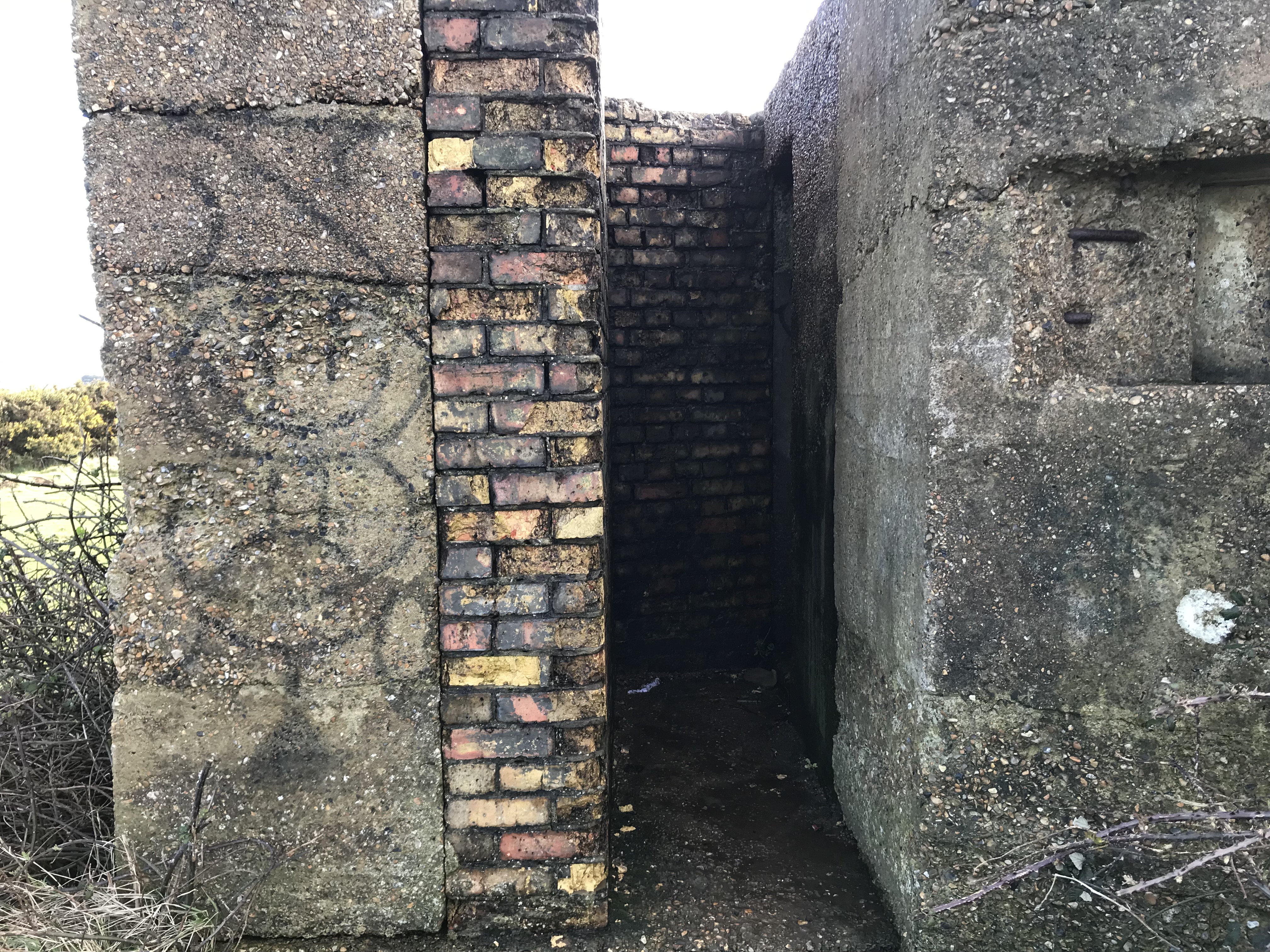
The interior blast walls are usually X, Y, or I-shaped, depending upon type, function and location of the pillbox, and stand floor-to-ceiling. Somewhat akin to their original function, one might expect the blast walls to provide some separation of sound entering through left and right embrasures and reflect sound back into its share of the space.

Exterior blast walls are optional add-ons to protect the entrance, and come in various shapes and sizes, material and thickness, attached or detached, covered or uncovered. They may mask some directional sound but may also act to funnel sound through the entrance way.
The Recordings
For the recordings, I used a portable XY-stereo recorder (Zoom H4n). This was positioned inside the entrance of the pillbox, raised on a tripod to the level of embrasures, and facing the centre so that left and right microphones are directed either side of the central blast wall. The device was left to record for 5-10 minutes while I retreated to listen, observe, make field notes and take photographs.

I have intentionally left the recorded material unprocessed and unedited in order to preserve, for example, the sound of my footsteps at the start and end of the recordings which may help convey to the listener the conditions of the space.
All recordings were made between 0930 and 1100 hrs in the last two weeks of February 2024.
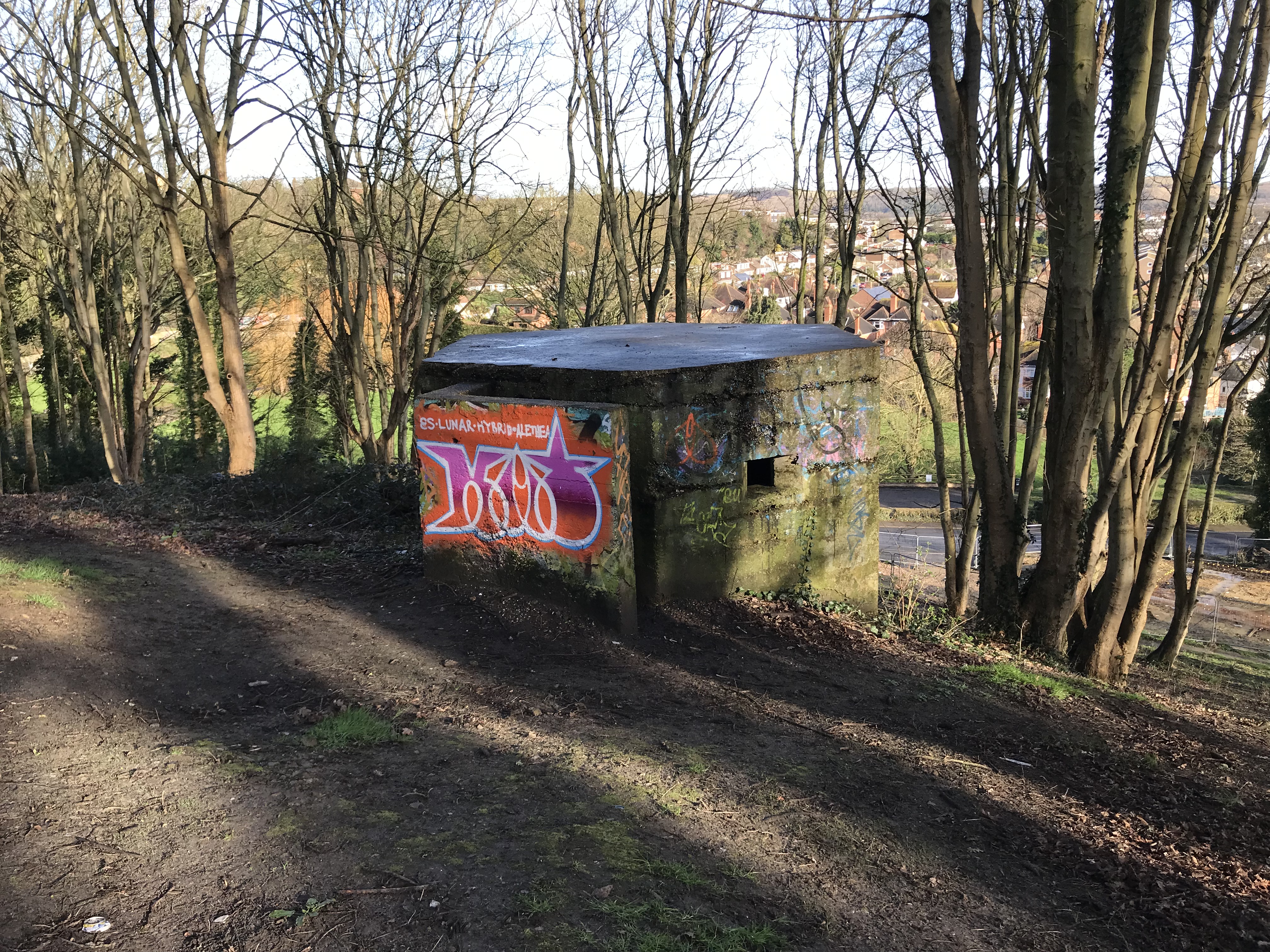
Military Road is perhaps the closest pillbox to the centre of town. Hidden on a sloping patch of woodland, opposite a quiet recreation ground, it stands about 30 metres from a Martello tower, looking onto a road leading up from the coast at Sandgate to the historic barracks at Shornecliffe. It is a Type 22 pillbox with walls 15” thick, an I-shaped internal blast wall and L-shaped exterior blast wall, both around 9” thick. It has five embrasures of the smooth splayed design, all remain open.
The recording is dominated by the vocalisations of small and medium birds in the surrounding woodland. There is occasional traffic. Magpies and other corvid sounds seem to blend into the sound of a vehicle reversing?! Somewhere a cockerel crows, and seagulls further in the distance. A sense of the shape of the valley and the land sloping coastward. There is some wind interference towards the end, through lack of a windshield.
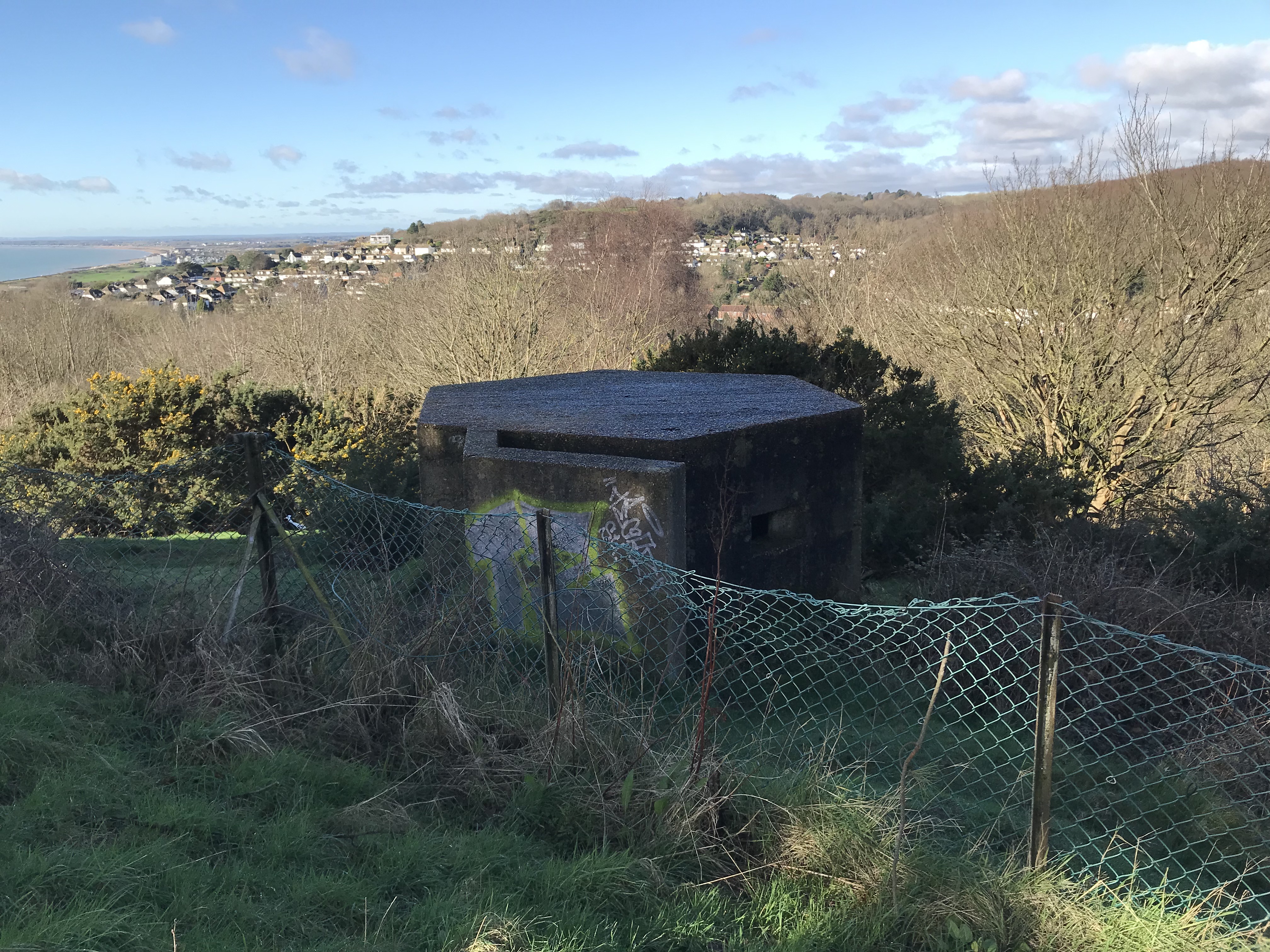
Shornecliffe Cemetery pillbox is located just beyond the western perimeter of the military cemetery, overlooking Seabrook valley and Hythe Bay. Another Type 22 pillbox, it has an I-shaped interior blast wall, and L-shaped exterior blast wall, both approx. 15” thick. It has five open embrasures with the same simple sloping design.
The recording is dominated by the drone of lawn mowers from grounds maintenance at the cemetery, interspersed with vocalisation of small birds in the surrounding gorse bushes. The sound of gun-fire drifts across from MoD land at St.Martins Plain, along with vehicular alarms and seagulls. Towards the end of the recording buzzards call through the neighbouring woodland.

The pillbox at Grove Farm sits on a bank, wrapped in ivy and obscured by trees at a T-junction of country lanes, a few metres from the Folkestone White Horse chalk hill figure and viewpoint. It is a Type 24 ‘shellproof’ pillbox, with an X-shaped interior blast wall. A 40” thick exterior blast wall attached at the roof creates a screen to protect the entrance. Its three open embrasures have been invaded by overgrowth.
The recording juxtaposes close proximity bird activity (outside and in?!), with the distant, ever-present transportation noise of the Channel Tunnel site at the base of the escarpment.

Danton Lane is a Type 24 pillbox located on remote farmland close to the abandoned Peene quarry, now a quiet picnic site. The structure is notable for its thick L-shaped covered blast wall protecting the entrance. Of the five stepped embrasures, one is partially bricked-up.
The soundscape is dominated by sound from the western end of the Channel Tunnel site. The larks I recall observing in the field have made a subtle impression on the recording, but can be distinguished from the closer proximity birdsong coming from a hedgerow, at the start of the recording.
The Type 24 ‘Shellproof’ pillbox at Cherry Garden Hill is peculiar not only because it was built into a Bronze Age barrow, but it is also seven-sided. Viewed from above, its outline resembles the spade (or pique) suit in a deck of cards. It is also the only site encountered to have a Y-shaped interior blast wall.
The soundscape is dominated by transportation noise from the east end of the Channel Tunnel complex, at its subterranean entrance, and from the M20 motorway beyond.

Creteway Down pillbox sits on the crest of the Folkestone Downs at an elevation of approx. 160 metres. On a clear day the view stretches across Romney Marsh as far as East Sussex.
The recording balances the sound of birdsong in surrounding gorse bushes, traffic climbing Dover Hill about fifty metres below, sound rising from Folkestone, planes overhead, and wind blowing through the embrasures.


Smallpox Hill pillbox lies further down the scarp and now only 10 metres from the main road. The lane is named after a Smallpox hospital that once stood on the site.
The recording is dominated by vehicles beginning to ascend Dover Hill, a grocery van unloads in the lay-by, plane flies overhead. There is no interior blast wall and sound is able to pervade the space.
Explore the Entrenched Sound Map
Resources
Exploring Kent’s Past (Kent Historic Environment Record), Kent County Council
Council for British Archaeology
Photographs by Craig Gell