
The gap itself is narrow. I could find my way in and could get out, but the leaving took more navigation. There was little space to turn around and I was mindful of my cumbersome human body, with its jackets and headphones, wires, unsteady from ongoing illness, and that each step crushed several beings at once. The composer Pauline Oliveros said that ‘listening is not the same as hearing and hearing is not the same as listening’. 1 It is also not a neutral act in practice. Observing the process of positioning myself to listen, I am aware of my tread, however careful, on oxalis, chickweeds, saplings, not to mention the increasingly smaller organisms below. The sounds of my body as I make my way through the field, similarly are a disturbance. Blackbirds flee and hoverflies and butterflies change direction. I thought again about boundaries. How could I ethically listen to a specific tree, previously struck by lightning, and other beings living, working and feeding here without continuing a subject/object split?
‘What does it mean to hear a plant?’ Anna M. Lawrence asks in her proposition of ‘vegetal geography’:
When being attentive to vegetal life, we look closely, we taste, we smell, we touch; perhaps we hear the rustle of leaves in the wind or the groaning of a branch, or the rattle of seeds in a poppy head. But to hear is not just to perceive sounds through our ears. It is also to listen with attention and understanding – to give ear to.2
Here, listening is both embodied and metaphorical, an active attentiveness across many senses. My practice explores how listening can engender attentiveness to more-than-human lifeworlds, agency and temporalities through field practices. I’m interested in how the embodied nature of listening opens up the listener to considerations of intimacy and empathy across species bodies, and of the field as a place of unsettled boundaries between disciplines, bodies and experiences of time.
In their article ‘Keeping Time with Trees’, Chris Gibson and Andrew Warren describe how foresters, in this case those growing timber for acoustic guitars, are ‘experimenting along a stretched temporal plane’.3 Thinking about the lifetimes of trees in this way is a kind of temporal thinking-with, signalling a shift in thinking from human time to ‘vegetal time’.4 To do so is a route into future-orienting our contemplation on what Anna Tsing describes as ‘life without the promise of stability’.5 Thinking of this future without promised stability, foregrounds the importance of asking questions around how we live with and ‘construct economies with and among other beings (rather than in dominion with them)’.6 With this in mind, I want to ask how does thinking, feeling, and listening with and alongside a tree destroyed by lightning allow me to practice what Thom van Dooren and Deborah Bird Rose describe as practices of ‘attentiveness’ and ‘lively ethnography’,7 and respond to Tsing’s proposition of the ‘arts of noticing’ and ‘passionate immersion’8 in the lifeworlds of more-than-humans? How do methods of immersion and attentiveness reveal a multiplicity of relations, temporalities and entangled ways of being within ‘multispecies assemblages’?9 Can these prominent methods, distinctly employed by multispecies studies researchers, be enacted through recording within trees, even those whose growth and cellular liveliness has abruptly ended through injury?
Adopting attentiveness as the foundation to my listening practice, and encouraged by Gallagher et al’s proposition of ‘expanded listening’,10 I consider how such practices enact an intimacy beyond the human, whilst problematising the absence of a shared verbal language between species. Exploring the sharing of vibrations through arboreal and fleshy bodies, facilitated by listening, I hope to respond to Patrick Farmer’s call for submissions to this edition of row of trees:
vibration as/in relation, like a series of shimmering lenses through which one field might perceive another and itself, or one animal might feel another.
Enacting a back-and-forth dialogue between multispecies ethnography and autoethnography, considering how sound recording practices give rise to revelations and difficulties relating to both approaches, I will consider subjects of intimacy, conceptualisations of the field, blurring of species boundaries and temporalities as multiple and ‘co-constructed across species’.11 I’ll also think about fieldwork as an intimate negotiation that is both felt and embodied across varying bodies. What does the ambiguity and inability to differentiate each sound source within field recording, especially when that is abstracted further through contact microphones, and the temporal lag involved in listening back at the studio, allow us to know? Anthropologist Natasha Myers asks, ‘what do the trees know? If we learned to listen, what stories could they tell?’12 With these questions in mind, I began a speculative project, laying few parameters on my recording techniques and developing my fieldwork approach over repeated returns to the same location.
Contingency and embodiment in the field

The field in this paper is a mixed wooded meadow near the River Tweed in the Scottish Borders, neither far from industry, exemplified by the local quarry and busy road to Glasgow, nor low in biodiversity. The area is home to ravens, orchids, linnets, violet ground beetles and migratory visitors such as ospreys, spotted flycatchers, enacting their varying interactions with the wide river, banked by mixed deciduous trees and Scots pine. With a well-worn footpath cutting through the meadow, this field is overtly a shared space, a site of encounter across diverse species bodies. This location resonates with cultural geographer Harriet Hawkins’ description of the field as ‘an unsettling space that puts into into question disciplinary identities and methodological strategies’.13
I first visit this space, with the intention of using contact mics, hydrophone and field microphones, on a dry day in early Spring. At the end of the previous summer, the solitary Japanese larch in the meadow had been struck by lightning and split in two. The subsequent fire hollowed the inside of the trunk.

Recording with my equipment is contingent on a number of factors, not least the weather, but also more embodied factors such as a window of good health within an irregularly presenting auto-immune condition. Hawkins quotes the historical geographer Felix Driver who urges geographers, to pay more attention to ‘the materiality of the field, the contingency of encounters within it, and the embodied practices of fieldworkers themselves’.14 I play close attention to my own embodied experience of listening within this space and the contingencies and multiplicities that become noticeable through this practice of listening. These are particularly evident in the seasonal patterning of some species’ habitations and the related sounds and vibrations they bring to this space, but also through the rarity of the lightning strike: how it altered a tall, dense tree bough into a hollow wooden chamber. These contingencies combine with my own embodied responses to the space and the listening process. I am responsive, often moving, listening shaping where I next focus the microphones. Listening to the meadow, across several months and two seasons, I experienced a sensory response to timely patterns of more-than-human activity: migration, first leafing, full leafing, full flowering, mating, living and dying. In this way, sound allowed an embodied participation into spaces, aiding a sensitivity to more-than-human interactions and temporalities.
Through repeated visits, I became more attentive to the temporal rhythms around me and in which I was participating through my own practice. The ambiguity of sound, when occurring through vibrations from and across diverse bodies in the field, allows for a joining and participation of my listener’s body with those of others: the sounds I hear cause affective and physical responses within my own body; the embodied methods of listening, the tread of my feet as I reach the site and place the equipment, affect the more-than-human inhabitants around me. I try to pull back from objective descriptions of the space, reminded of Natasha Myers call to resist practices that ‘render the world legible to the constraints of our colonised imaginations’,15 with the legacy of those practice in western scientific thought (see also Palmer16), and allow a more emergent sensitivity to temporalities and life-worlds beyond my own, ‘to step into not knowing as an ethic and a practice’.17
Hawkins, asks whether the cave in which she conducts research with the artist Flora Parrott can be considered a ‘sensory field’,18 as the fieldworkers become attuned to very different spaces from those they often inhabit. Becoming sensitised to one’s own body, fieldwork also constitutes ‘an embodied sensory practice’.19 Hawkins and Parrott’s practices resonate with wider accounts of doing fieldwork through the body, where the body is cast as a kind of sensing device. Setting up my equipment, I extend the reach of my body as a sensing device through electronic prosthesis: the hydrophone collects sounds of dew drops falling between the leaf shoots of the cleavers that have just started to grow within the hollow larch; the contact mic records the vibrations of the early Spring wind as it brushes forcefully against the tree and knocks last year’s thistles against the bark. Multiple translations of the experience of space occurs through these experiments. When I bring this first set of recordings home and re-listen through my computer, I recreate only a very partial experience of being in the meadow that day. This paper, too, is limited and partial in its recreation of my experience of this particular place and resonates with Hawkin’s assertion of the field as a site for the unfolding of creative practice and geographical research relations that includes ‘folded modalities’ and ways of conducting field-based work.20 Taking the recordings home and cleaning up some of the noise, I note that there is a kind of performativity in recreating the space on my computer, with the temporal instance of the recording folded up within that of the edit; the sounds that were audible to my ears within the meadow, with all the affective responses they illicit, undergoing a vast abstraction through the particular tonalities of the recorder and software. This temporal flattening expressed also in the reduction of the previous years’ plant growth and their affects on the recording down to the single minute-long file.
Two-way responsiveness as a sharing of intimacy across species?
These folded modalities of fieldwork and the work of creative practice lead me time and again to ideas of intimacy though listening. Sound often features in acts of human intimacy, whether across speech, or the co-listening and sharing of experience through sound. There is an internalised sensation of external experience, as vibrations from beyond the body are processed within. Here, I am trying to find ways that sound can also be a method of sharing intimacy across (often reductive) boundaries between species, such as human and tree, begging the question: how can intimacy be enacted in the absence of a shared verbal language? Is listening, when shared as vibrations, through arboreal and fleshy bodies together, a care-full approach in attempting to know another21 or a kind of eavesdropping – a listening in without permission, an intrusion? Is intimacy itself a form of shared language even if some of the party is not consciously participating?
Often questions of projection and anthropomorphism enter here. Myers argues against reductive accusations of anthropomorphism in these kinds of speculative experiments asking whether the accusations ‘aren’t themselves too mired in colonial imaginations of nature and culture’.22 Myers instead suggests ‘that the stories we tell ourselves about nonhumans do not always involve a one-way imposition of human characteristics on non-humans’. Myers cites the example of life science practitioners who ‘become so intimately entrained to the beings and doings of the organisms they study, that they find themselves expanding their all-too-humans sensorium (often through technological prosthesis) to tune their bodies and imaginations in to meet the richly sensory worlds of the non-humans they study’.23 Throughout my returns to this field, I hope that listening will allow me to follow Myers’ life scientists in giving myself over to my inquiry in such a way that they continually become with and alongside the living beings they study. This two-way responsiveness, the human becoming more plant, more tree, is also emphasised by the artist Laurie M. Palmer. In The Lichen Museum, Palmer argues that the physicality of attending to lichens questions ‘the primacy of upright postures, quick steps, sweeping gestures, and the policing of public space’.24 The same questions present when listening close to the trees in this meadow, particularly when listening within the larch. I become conspicuous in areas where human, dog and deer paths intersect and where I am standing apart, headphones on, crouching within a hollow tree, touching that tree as the contact mic collects the intimacy, and perhaps digression, of that gesture. I am keenly aware that the interaction alters the shape of my body. My head leans involuntarily, to listen more closely, drawing curious looks from people close by, their conversations sometimes faintly audible on the recordings.
Participating in the field through witnessing. Becoming changed in turn.
On the second visit, the only break in the weather was Good Friday. I knew, passing others walking along the path by the river, that anything I recorded today would include the holiday traffic from the busy road to Glasgow up on the hill and people calling each other and their dogs. A man on the opposite side of the river was pulling branches off a fallen tree for a fire, their stems making great snapping noises as he crushed them with his boot. Due to the shape of this part of the Tweed valley, the sound migrates around the space for longer than I anticipate, the echo of a longer duration, causing a caught breath in reaction to this reshaping of a temporal experience within the body. There really was no way of being alone with the tree and I reproached myself for trying to find a spot withdrawn from human activity, and falling into the trap of a nature/human binary in which I didn’t want to participate. Dominic Pettman notes in Sonic Intimacy that, although there might initially be a ‘temptation’ to retreat and ‘escape all human-made sounds’, this can only ever be partial and that ‘attending to the environment is a highly ambiguous experience when ecology and industry are so intertwined’.25 This is immediately evident in the particular features of the field I am working within, and through an awareness that my equipment has its own geographical, technological, extractive and global market histories.
The tree itself seemed to have grown darker since I last visited. The charcoal was a deeper black on its inside and the bottom of the hollow trunk was filled with taller cleavers, not yet sticky. I placed the field recorder down on the nearby grass and looked back a moment later to find a tick climbing the dials, drawn by the vibrations of my movements and other tempting signals of my presence in the space. I tucked my trousers into my socks, remembering reports that tick-borne encephalitis had made its way to Scotland, migrating through ticks and across species bodies.
I had two contact mics but neither responded the way that I had hoped. I couldn’t pick up a particular sound of my body through the bough of the tree as planned. I interrogated my frustration at this: that I had decided to move into the tree and demand of our time together a predetermined outcome. Instead, I placed the contact mic around the cleavers within the trunk’s base and listened to the stems reverberating as they sprung back against the clip. Small beetles crawled between the hairy stems and over the mic, creating a faint cracking sound as the vibration of the journey left its mark in the recorder’s data. I had forgotten that in my proposal I planned to look at boundaries between myself and the tree specifically, and wondered why I had forgotten that neither of us could be reduced to singularities within a space. Although the tree, as a categorised member of the species larix kaempferi, was no longer growing or regenerating, its remaining body was teeming with liveliness. A large ant crawled over my boot; pink purslane grew among the roots; a clear, almost colourless mite investigated the contact mic as I clipped it to the side of the trunk, near the great split that felt like a doorway and a portal and a wound.
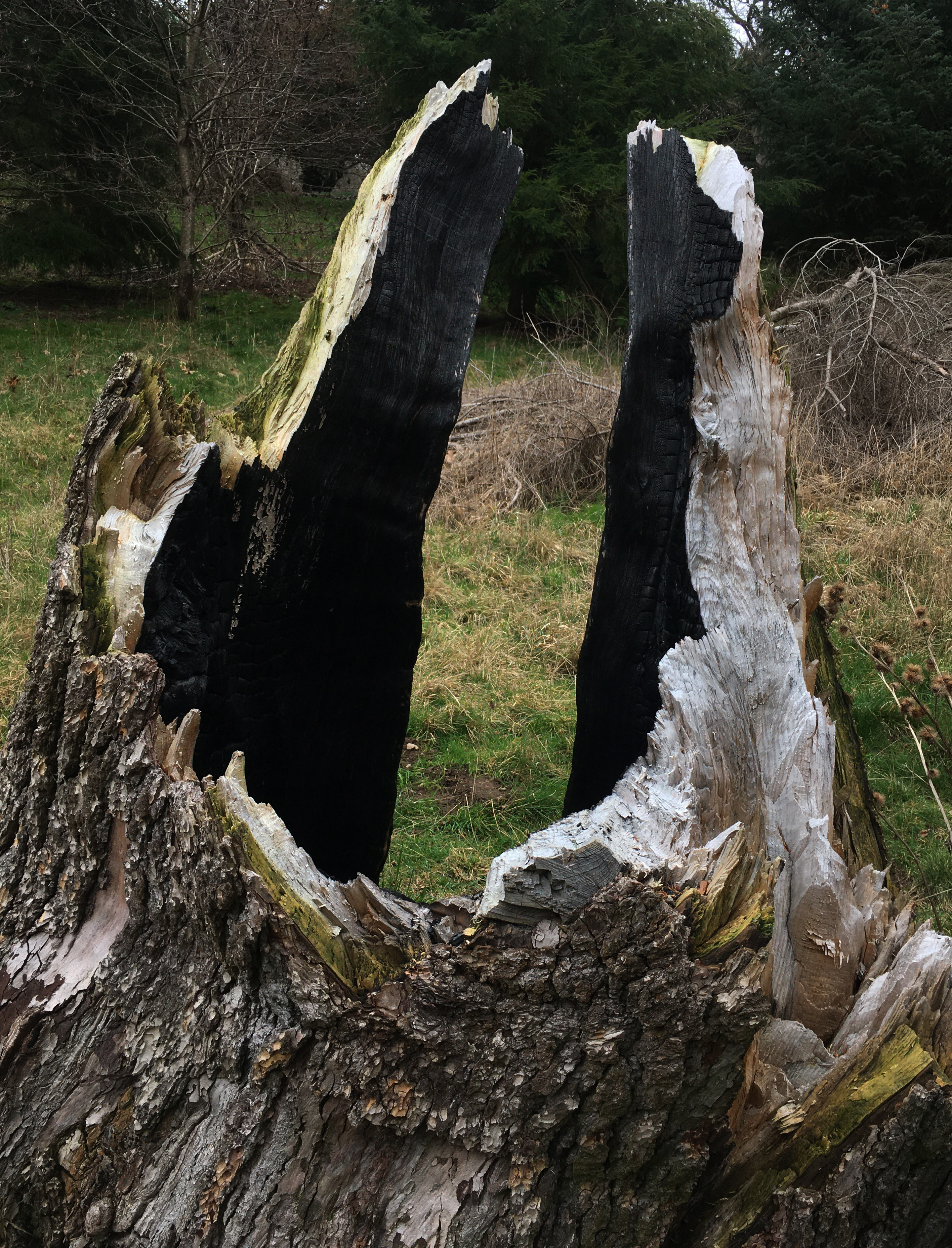
The process of listening surprised me more so than with previous field sessions. Recent reading on more-than-human ethics, agency, time and multispecies studies, foregrounds the vitality of relationships between species other-than-human, without the need for human validation of these relationships, and has continually influenced my changing experience of field listening. Going into a space with the intention to collect/extract/take-back the sounds I needed fell far short of the reality that I was being changed by the space and what I heard and what I was affected by: examples of Myer’s two-way responsiveness, problematising anthropomorphism. I recommitted to my intention to be attentive, receptive, allowing whatever could offer a vibration to do so, without my needing to decipher and compartmentalise these vibrations down to smaller and smaller typologies.
A week later, as I set up my equipment for a further time, I thought about Tim Ingold’s references to ‘think do’ in relation to drawing: ‘we do not first observe and then go onto describe a world that has already been made… rather we join with things in the very presses of their formation and dissolution’26 and that art is concerned with ‘reawakening our senses and to allow knowledge to grow from the inside of being in the unfolding of life’.27 This joining with things in their formation, unfolding and dissolution, presented a switch from listening to witnessing, a returning to the Harawayan being-/thinking-with, Myers notes earlier.28 Louise Boscacci talks about ‘wit(h)nessing’ as ‘a bodily encounter with shared earth others—kin, commensal, prey, predator’ that ‘is always an encounter-exchange’.29 I allowed myself to participate in the space, becoming receptive to the vibrations as I felt them in my body, through my ears, and through the recorders. Receptive also to the vibrations, audio or otherwise, that my body would be expressing that would alter the paths of the ants, draw in the ticks and trigger the wren to send out its alarm call when I came too close to the yew tree in which it was flying. Aware also of the limits of trying to anticipate what about me would be a disturbance to the consciousness of beings different than myself.
Later, I showed a friend a picture of my hydrophone with a contact adapter on the larch’s root, supporting several species of moss. The moss was warming in the sun and still damp from the morning’s rain. The recording was surprising. The moss, tiny insects, water, air, perhaps bryophyte respiratory processes, combined ambiguously with the particular voice of the hydrophone to relay crackling, popping and fizzing. Like the sound inside my body when I rotate my clicking neck. The friend asked what processes specifically it was that she was hearing. I do not have biological scientific experience and I remained reluctant, for all the reasons I’ve mentioned above, to use the vibrating sound to ‘identify’. I wanted instead to witness and be attentive to vibrations I otherwise could not be attentive to without extending my senses through technological prosthesis.

The vibrations increased my sense of spatial-volume in relation to the meadow, different to my sense of the space experienced through my ears only: cars, people talking, a labrador panting as it charged towards me for a wayward ball. Attuning myself more to listening/witnessing within the space, I heard both more specificity in the bird calls, hearing chiffchaffs, the changed call of the mistle thrush now winter was over, and more ambiguity as these sounds came together with the chorus of a mixed woodland rustling in the spring wind. During the limbo of changing microphones, using the x/y mics on the top of the recorder in the interim, I also experienced a temporal abstraction of the sounding of the space. Listening with my ears only, I became more aware of the small delay transmuted between the immediacy of encounter and translation through data when listening through the recorder with headphones, as well the equipment’s amplification of the wind and the busy flight path of the planes heading to Edinburgh. Time felt more layered, thicker, whilst any singular experience of time became less certain. There was an infinite amount of living, dying, breathing, moving, eating, respiring in the space. Alternating between only my body and body+listening device, allowed me to slowly attune to this thickness, this multiplicity of connections and temporalities and lack of certainty.
Perceiving another and oneself through the field. Perceiving oneself in response to feeling another.
Later, when listening to the recordings, I think about the translation of human initiated movements creating acoustic vibration through wood-based instruments to sound. How the vibration we cause through bow, finger, plectrum, breath, borrows the resonance of wood to change and extend our self-expression to a voice that is not human but also not tree. Some of my recordings feature the sounds created by my hands as they touch the outside of the larch, gestures of empathy for its wounding, recorded through contact mics connected to the bark. Returning to the larch some weeks later, early summer beginning, I allow myself instead to be vibrated by the joint impact of the wind around the burnt-out larch: I feel my body resonate as a gust charges against the grey bark on the outside, vibrating through the remaining timber and enter my body through my back. A contact mic on the bark picks up the vibrations of the wind’s impact, whilst a mic on my chest simultaneously picks out my heartbeat as it increases in response. I remember the direction of movement from human to acoustic instrument vibration. This time, the resonance has changed direction: wind to wood to human body to human heart beat. The intimacy of this exchange strikes me. The call for papers for this edition of a row of trees beautifully considers how ‘one field might perceive another and itself, or one animal might feel another’ through vibration. I want to add to this the sense that one being might further feel or perceive themselves through response to feeling another. It is difficult not to consider the act of listening as part of an intimate exchange. Listening attentively between humans, acknowledges the value of the experience of another. I perceive that, through listening attentively, this practice can draw attention to and greater acknowledge the co-production of space and understandings of time in relation to multispecies interactions, whilst being cautious of problematising rather than reinforcing the nature/culture divide or object/subject binary of the Western knowledge traditions. These practices are full of risk, and Lawrence warns that ‘on the one hand, a separate “vegetal geography” field could be considered reflective of the restrictive projects of hierarchical classification which multispecies work tries to problematise’.30
Feeling the back of my body pressed against the tree, I wonder why I feel inhibited from participating in these kinds of intimate actions of attentiveness more often. Walking along the river, I often touch the Cypriot pine, the trunk of the holly, and stop to listen to the few-months-a-year-only rustle of the aspen that sounds to some like running water and to others like a breathy shivering. When other walkers appear, I participate in a kind of theatre where I pretend to not be doing what I was doing, sensing some kind of shame in crossing a perceived human/more-than-human boundary of attentiveness and being witnessed. Perhaps being judged for paying more attention than I should be. This inhibition is troublesome for the field researcher, whether enacted through geography, anthropology, art or sound methodologies. Conducting human performative behaviours, so instinctual after years of socialisation (but also localised and not at all universal), becomes a learned intrusion into what I really want to be doing, which is to listen, to smell, to touch and to see as a way of witnessing, a way of fully participating in Hawkins’ ‘sensory field’.
Tuning in to multiple temporalities through field listening
Returning to Keeping Time with Trees, Gibson and Warren’s analysis of ‘stretched temporal planes’, highlight the alterity of tree and forest temporalities, examples of Lawrence’s ‘vegetal time’. Lawrence notes that ‘even the temporality of the garden plant is not their own, but is that of their Other, be that the diurnal cycles of light and dark or the calendars of insect pollinators’.31 In comparison to those of humans, tree, plant and lichen time patterns present across multiple seasonal rhythms within the year and growth over lifespans, often beyond human timescales. At first consideration, this doesn’t seem to easily meld with the intermittent listening session. In mid-summer, I return again to the meadow and the tree. The chiffchaffs have changed their tune, the cleavers are almost a metre high and I am reminded of Natasha Myers’ questioning of what ‘here’ means in relation to her experiences of the Toronto Black Oak Savannah, when more-than-human assembled landscapes alter across seasons and yearly cycles, with varied human and environmental influences experienced across long duration time-scales: ‘the ‘here’ that we experience now was a different ‘here’ when these trees were young’.32 What makes a ‘here’ when landscapes are always changing? What makes a sonic ‘here’, when soundscapes are always in flux across varying vibrational bodies and temporal planes?
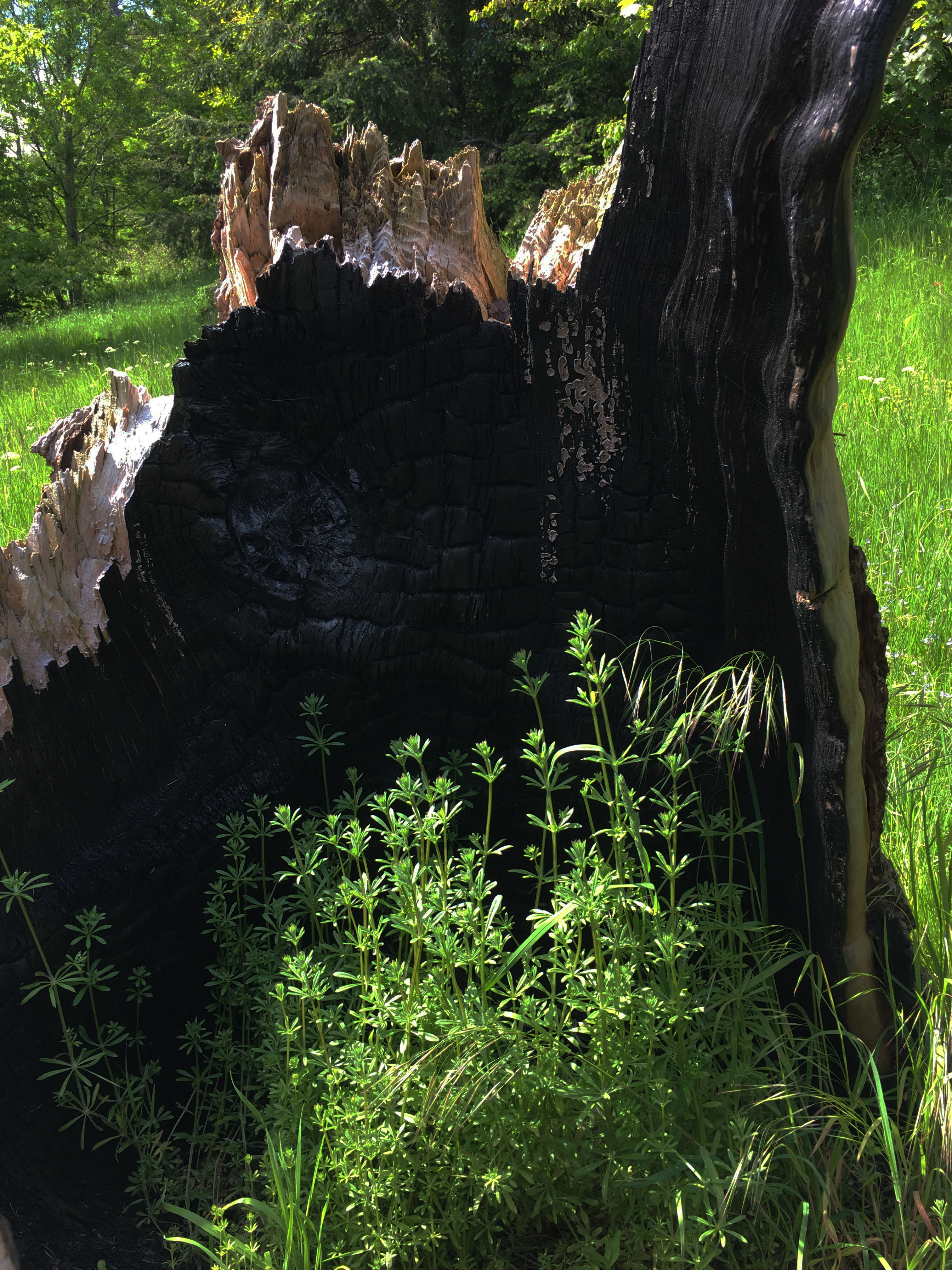
One way that sound can engage with forest temporalities is in its ability to shift focus from plants and trees as objects of memory, or ‘undifferentiated collectives’, ‘background as environment or ecosystem’ and ‘living objects’,33 or the flattened specimens within medieval herbariums and allegorical images in art history,34 to beings and assemblages with their own biographies and genealogies. Sound allows me to tune my body in to temporal instances within these genealogies, the process for which becomes a kind of enskillment in careful looking as well as listening. In the paper ‘Ghostly Forms and Forest Histories’, anthropologist Andrew S. Matthews describes an emergent enskillment in reading past histories of forests through his practice of ‘walking, looking and wondering’.35 Allowing the tracing of entangled relationships across trees, animals, people and soils, histories emerge through attentiveness to the contemporary landscape. A comparable embodied awareness of historic entanglements can be reached through sound. As I record within the burnt-out larch, I am aware of the catastrophic lightning blow the tree experienced to allow such a hollow chamber to exist. Laying my equipment down draws my attention to the rich carbon substrate that now provides nutrients to the bed of vegetation vying for the light channeled through the opening. There are traces, perceptible through the recording, of the contemporary industrial and animal entanglements that shape the space. I can hear the quarry and road through the contact mic, their vibrations moving through the air, the ground and the bark of the tree. Even the process of attention involved in finding a place for the mics, draws my attention to the species indicator of the tree. A Japanese larch, not native to Scotland, with its own biography of migration, and histories of multispecies interactions.
Listening through the tree in this final listening session, I think about the particular coordination of resonances facilitated by the lightning wound: just one instance of the tree’s biographical history. Environmental fluctuations from previous years, such as wind, rain, and dry summers are writ into the tree’s rings like vinyl grooves. These fluctuations, like vibrations through time, also affect the resonance I am experiencing: the thickness and channels of the outer bark and roots, the only parts that remain after its catastrophic wounding. The past, here, vibrates the present and destroys a sense of linearity, just as the present of my recording experience, becomes swift history when I re-experience the recordings back home.
The meadow is slowly reforesting itself. A young rowan behind me is in flower, only a couple of years old, growing seeds for further dispersal of its kind. Lawrence reminds the reader of the ‘complex temporalities folded within the body of seed’, holding ‘the capacity to make visible past landscapes and co-construct imagined futures within diverse communities’.36 Taking up Myer’s ‘phytopomorphism’, Lawrence notes that attention to this ‘invites us to ‘vegetalise’ our already more-than-human bodies and attach ourselves to the things which plants care about’.37 This takes time. The reader may have noticed that my reluctance to reduce sounds to species has not played out in practice. I am aware of the contradiction present in a habit of orienting my body in spaces by identifying species, pulling out species in the recording and noting their names in relation to temporal patternings, such as seasonality and migratory presences/absences. For me, Hawkins folded modalities present as a tension between immersing myself within a space and allowing it to affect me, and my instinct to orient the timings of seasons, the biodiversity health of the valley, the differences between this year and another through the listing and categorisation of what I can hear. Through sound practices, both of these instincts lead ultimately to a desire to deepen awareness of, and sensitivity towards, those more-than-human others living within this space. Sound also supports an aversion to the flattening of landscape as a backdrop to human experience by immersing myself as a participant within it.
Questions + practice leading to more questions
Recognising that I am likely not a welcome participant to many actants further troubles the ethics of methods involved in multispecies ethnography and my awareness that many questions remain unanswered. Neither are my practices aiming to simply raise awareness or adopt ‘a paternalistic rhetoric’ of ‘giving voice’38 to nature so that we might protect it better. I do not believe art’s only role is to be instrumentalised to serve an ecological goal or be the public-facing voice for others’ scientific research. Art, here, through listening and sound, allows for questions to be asked, felt out, in practice. Palmer asserts that ‘art is multimodal: it engages multiple ways of coming to know (sensing, thinking, imagining, projecting, experiencing in time), without fixing knowledge as a thing for sure’.39 Extending the body and extending other bodies towards my own body through sound allows me to consider subjects like intimacy, care, boundaried/boundariless bodies without providing a tidy solution. This is what sound and listening can do. Listening on these occasions allowed me to think and be affected by the space. It increased my sense of spatial and temporal volume, further layering and thickening the space through the influence of the recording prosthesis. Returning to Thom van Dooren, Deborah Bird Rose, and Anna Tsing’s calls to attentiveness and immersion in order to amplify the meaningful lives of others, my approach was speculative but has given me much to think about as I develop ways to consider more-than-human temporalities through art based approaches. The process enabled me to experience an extension of the the texture of a temporal-spatial situation, extending the ways in which I can become affected and participate as a witness; how I might enact practices of ‘wit(h)nessing’ whilst acknowledging my own presence as a disturbance. Niccola Di Croce writes that focusing on ‘disturbance’ through sound and vibration, allows a reframing of the ‘relationship between humans, non-humans and matter’,40 ultimately enabling considerations of sonic and physical coexistence. Through field recording, I am able able to advance into heightened attention of ‘worldly sounds, the vibrations of the multiplicity of beings, materials, and forces that come together to form environments’,41 whilst reaffirming the problematic blurriness of nature/culture narratives as they are enacted through our orientating of ourselves within spaces.
References
Aloi, G. (2019) Why Look at Plants: The Botanical Emergence in Contemporary Art. Leiden: Brill
Bastian, M., and Bayliss Hawitt, R. (2023) ‘Multi-species, ecological and climate change temporalities: Opening a dialogue with phenology’, Environment and Planning E: Nature and Space, 6(2), pp. 1074-1097. Available from: https://doi.org/10.1177/25148486221111784 [accessed 15.04.23]
Boscacci, L. (2018) ‘Wit(h)nessing’, Environmental Humanities, 10 (1), pp. 343–347. Available from: https://doi.org/10.1215/22011919-4385617 [accessed 01.10.22]
Di Croce, N. (2021) ‘Attuning to Disturbance: Towards a multi-species sonic ecology’, Sonic Urbanism: Listening to Non-Human Life. London: Theatrum Mundi [online] Available from: https://theatrum-mundi.org/library/attuning-to-disturbance-towards-a-multi-species-sonic-ecology/ [accessed 12.10.22]
Gallagher, M. (2015), ‘Field Recording and the Sounding of Space’, Environment and Planning D: Society and Space, 33, pp. 560-575. Available from: https://doi.org/10.1177/0263775815594310 [accessed 14.10.22]
Gallagher, M., Kanngieser, A., Prior, J. (2017) ‘Listening geographies: landscape affect and geotechnologies’, `Progress in Human Geography, 41(5), pp. 618-637. Available from: https://doi.org/10.1177/0309132516652952 [accessed 14.10.22]
Gibson, C., & Warren, A. (2020) ‘Keeping Time with Trees: Climate change, forest resources, and experimental relations with the future’, Geoforum, 108, p. 325-337. Available from: https://doi-org.ezproxy.is.ed.ac.uk/10.1016/j.geoforum.2019.02.017 [accessed 03.03.23]
Hawkins, H. (2020) Geography, Art, Research: Artistic Research in the GeoHumanities. London: RoutledgeIngold, T. (2013) Making: Anthropology, archaeology, art and architecture. London: Routledge
Lawrence, A., M. (2022) ‘Listening to plants: Conversations between critical plant studies and vegetal geography’, Progress in Human Geography, 46 (2), pp. 629-651. Available from: https://doi.org/10.1177/03091325211062167 [accessed 02.06.23]
Matthews, A., S., (2017) ‘Ghostly Forms and Forest Histories’, in A., L., Swanson, H., Gan, E., Bubandt, N., (eds) (2017) Arts of Living on a Damaged Planet: Ghosts and Monsters of the Anthropocene. Minneapolis: University of Minnesota Press, pp. 145-156
Myers, N. (2017) ‘Becoming Sensor in Sentient Worlds: A more-than-natural history of a black oak savannah’, Bakke, G., and Peterson, M. (eds.), Between Matter and Method: encounters in anthropology and art. London: Routledge. pp. 73-96
Oliveros, P. (2005) Deep Listening: A Composer’s Sound Practice. Indiana: iUniverse
Palmer, A. L. (2023) The Lichen Museum. Minneapolis: University of Minnesota Press
Pettman, D. (2017) Sonic Intimacy: Voices, Species, Technics [Or, How to Listen to the World]. Stanford: Stanford University Press
Puig de la Bellacasa, M. (2017) Matters of Care: Speculative Ethics in More Than Human Worlds. Minneapolis: University of Minnesota Press.
Rose, D., B. and van Dooren, T. (2017) ‘Encountering a More-than-human World: Ethos and the arts of witness’, Heise, U., Christensen, J., Niemann, M. (eds.) The Routledge Companion to the Environmental Humanities. London: Routledge, pp. 120-128
Tsing, A., L., (2011) “Arts of Inclusion, or, How to Love a Mushroom”, Australian Humanities Review, no. 50, pp. 5-22. Available from: http://australianhumanitiesreview.org/2011/05/01/arts-of-inclusion-or-how-to-love-a-mushroom/ [accessed 02.08.2022].
Tsing, A., L., (2012) ‘Unruly Edges: Mushrooms as Companion Species: For Donna Haraway’, Environmental Humanities, 1 (1), pp. 141–154. Available from: https://doi.org/10.1215/22011919-3610012 [accessed 28.02.2022].
Tsing, A., L. (2015) The Mushroom at the End of the World: On the Possibility of Life in Capitalist Ruins. Princeton: Princeton University Press.
Tsing, A., L. (2017), ‘A Threat to Holocene Resurgence Is a Threat to Livability’, M. Brightman, J. Lewis (eds.), The Anthropology of Sustainability. Palgrave: London, pp.51-65.
ENDNOTES
1 Oliveros, P. (2005) Deep Listening: A Composer’s Sound Practice. Indiana: iUniverse, p.21
2 Lawrence, A., M. (2022) ‘Listening to plants: Conversations between critical plant studies and vegetal geography’, Progress in Human Geography, 46 (2), p.629
3 Gibson, C., & Warren, A. (2020) ‘Keeping Time with Trees: Climate change, forest resources, and experimental relations with the future’, Geoforum, 108, p.326
4 Lawrence, Ibid, p.631
5 Tsing, A., L. (2015) The Mushroom at the End of the World: On the Possibility of Life in Capitalist Ruins. Princeton: Princeton University Press. p.2
6 Gibson & Warren, Ibid, p.326
7 Rose, D., B. and van Dooren, T. (2017) ‘Encountering a More-than-human World: Ethos and the arts of witness’, Heise, U., Christensen, J., Niemann, M. (eds.) The Routledge Companion to the Environmental Humanities. London: Routledge, pp. 120-128
8 Tsing, A., L., (2011) “Arts of Inclusion, or, How to Love a Mushroom”, Australian Humanities Review, no. 50, pp.5-22.
9 Tsing, A., L. (2017), ‘A Threat to Holocene Resurgence Is a Threat to Livability’, M. Brightman, J. Lewis (eds.), The Anthropology of Sustainability. Palgrave: London, P.52
10 Gallagher, M., Kanngieser, A., Prior, J. (2017) ‘Listening geographies: landscape affect and geotechnologies’, `Progress in Human Geography, 41(5), pp. 618-637
11 Bastian, M., and Bayliss Hawitt, R. (2023) ‘Multi-species, ecological and climate change temporalities: Opening a dialogue with phenology’, Environment and Planning E: Nature and Space, 6(2), p.1074
12 Myers, N. (2017) ‘Becoming Sensor in Sentient Worlds: A more-than-natural history of a black oak savannah’, Bakke, G., and Peterson, M. (eds.), Between Matter and Method: encounters in anthropology and art. London: Routledge, o. 74
13 Hawkins, H. (2020) Geography, Art, Research: Artistic Research in the GeoHumanities. London: Routledge, p.31
14 Driver, in Hawkins, Ibid, p.30
15 Myers, ibid, p.75
16 Palmer, A. L. (2023) The Lichen Museum. Minneapolis: University of Minnesota Press, p.5; p.19
17 Myers, p.75
18 Hawkins, p.34
19 Ibid, p.36
20 Ibid, p.31
21 Puig de la Bellacasa, M. (2017) Matters of Care: Speculative Ethics in More Than Human Worlds. Minneapolis: University of Minnesota Press
22 Myers, p.74
23 Ibid, p.76
24 Palmer, p.2
25 Pettman, D. (2017) Sonic Intimacy: Voices, Species, Technics [Or, How to Listen to the World]. Stanford: Stanford University Press, p.65
26 Ingold, quoted in Hawkins, p.33
27 Ingold, T. (2013) Making: Anthropology, archaeology, art and architecture. London: Routledge, p.8
28 Myers, Ibid, p.76
29 Boscacci, L. (2018) ‘Wit(h)nessing’, Environmental Humanities, 10 (1), pp. 343–347
30 Lawrence, p.632
31 Ibid, p.635
32 Myers, p.73
33 Ibid, Lawrence, p.631
34 Aloi, G. (2019) Why Look at Plants: The Botanical Emergence in Contemporary Art. Leiden: Brill
35 Matthews, A., S., ‘Ghostly Forms and Forest Histories’, in A., L., Swanson, H., Gan, E., Bubandt, N., (eds) (2017) Arts of Living on a Damaged Planet: Ghosts and Monsters of the Anthropocene. Minneapolis: University of Minnesota Press, p.145
36 Lawrence, p.631
37 Ibid, p.636
38 Pettman, p.66
39 Palmer, p.7
40 Di Croce, N. (2021) ‘Attuning to Disturbance: Towards a multi-species sonic ecology’, Sonic Urbanism: Listening to Non-Human Life. London: Theatrum Mundi
41 Gallagher, M. (2015), ‘Field Recording and the Sounding of Space’, Environment and Planning D: Society and Space, 33, p.562