
Rhizomatic Repair is an emergent participatory ecological and intrapersonal engagement with mending. Practical knowledge sharing gives way to group writing praxis, the results of which literally feed worm communities, merging our byproducts with their own, creating compost to sprout toxin remediating botanicals and plants who will become the paper for future iterations of the practice.
During the pandemic, my friend and collaborator Alma Tetto, wrote an essay called Radical Repair and the call for imagination (see below), which was in part about orienting ourselves inside a fractured world by attending to the resonance and patterns of living language, tracing them back to the source of separation and the potential of experiencing revelation in total darkness. After my first reading of this essay I craved to hear it spoken, read aloud and to start a reading series centering repair.
Tailor and textile artist, Viktoria Gokun and I met at Community Chorus, a choir organized by Carolyn Pennypacker Riggs that emerged in LA during the uprisings surrounding the murder of George Floyd. I mentioned to Viktoria that I was deeply in need of opportunities to merge the practical and the emotional, to do explore some kind of embodied reflection on the mending that has come to pass since the pandemic and perennial tending to grief and growth. Viktoria, had been synchronistically wanting to offer mending workshops so we decided to organize a garment repair knowledge-share in conjunction with the reading series.
Prior to moving to LA I had been living in a remote wilderness studying permaculture and solidarity economy and felt intent on maintaining that way of life in the city. While in LA I tended to a community of worms in a vermiculture tower that fit onto my tiny patio and when temperatures dropped – they lived inside my closet. During that time I had come to know an artist named Maru Garcia who was providing people in south central LA with soil testing kits and lead remediating plants for their backyards, parks, and schools.
I began to shred my writing for the worms as carbon offerings and felt deeply affected by the idea that my inner and my energetic mulch crop would be decomposed and recomposed into nourishment for plants who were then able to repair some of the effects of civilization’s toxicity.
A vital element of Rhizomatic Repair is the work of Laura Sullivan Cassidy, an artist and writer, dedicated to end-of-life care, who for many years, opened up her home in Seattle for community gatherings called Write On. After telling Laura about my desire to merge the written carbon offerings into the garment mending a reading series, she divined a spell prompt called Isochronal Confirmations.

What emerged from this confluence is a participatory ecological and intrapersonal engagement with mending called Rhizomatic Repair. Practical knowledge-share sessions give way to group writing praxis, the results of which literally feed worm communities, merging our byproducts with their own, creating compost to sprout toxin remediating botanicals and plants who will become the paper for future iterations of the practice.
The other face of letting go is holding on, Rhizomatic Repair holds these faces in relation rather than in opposition.
Jerome and Diane Rothenberg refer to the poet as a “defender” of biological and psychic diversity, in this iteration of Rhizomatic Repair we tethered into the difficulty of being with our wholes, our incompleteness. Isochronal confirmation from Symposium of The Whole will be transmuted by the worm of Hay on Wye via the Compost Club at Hay Castle.
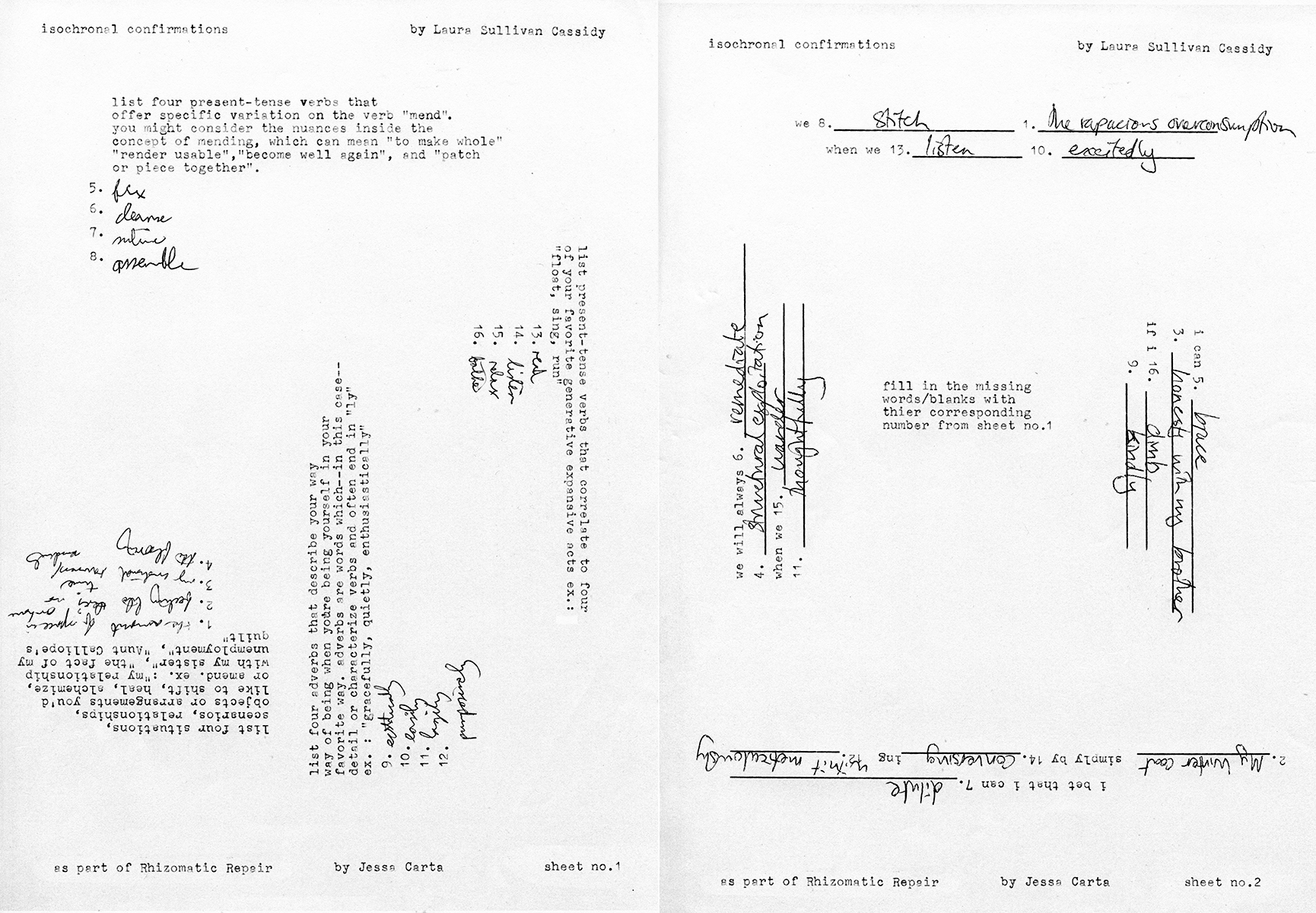
Image 1 – Rhizomatic Slug Trail
Image 2 – Squash Blossom Seeded From Rhizomatic Repair Compost Comprised in Part by Isochronal Confirmations
Image 3 – Page Three of Original Isochronal Confirmation Worksheet by Laura Sullivan Cassidy
Image 4 – Page Two of Original Isochronal Confirmation Worksheet by Laura Sullivan Cassidy
Image 5 – Isochronal Confirmations completed as part of Symposium of The Whole
Image 6 – Isochronal Confirmations completed as part of Symposium of The Whole
Alma Tetto – Radical Repair and the call for imagination
I wrote this piece in the spring of 2020, in a moment marked by global fracture—when the interwoven crises of pandemic, state violence, and structural racism exposed long submerged conditions of cultural dis-ease. The world, as many of us knew it, was coming undone. In the midst of immense collective grief, breathlessness, and upheaval, I turned to language not solely as a means of expression, but as a way of attuning to the deeper patterns at play and the generative and symbolic roots that might orient us within collapse.
2025 marks another year of profound systemic unraveling, where many of the structures that have shaped contemporary life are undergoing seismic shifts. The need for imaginative capacity—for ways of seeing, sensing, and cohering otherwise—feels more urgent than ever. I offer this piece again now not as a fixed statement, but as a trace: a record of inquiry into how we might listen more deeply, root more consciously, and participate in the ongoing work of radical repair. Even within collapse, there are openings—tremulous, emergent, and alive with possibility.
—
the last words of
a Black man
crushed under the
heavy weight
of Racism
the lingering words
in the mind
of both old and young
bodies deranged
by the Virus
the final words
of a world
dissolving into Chaos
to reclaim its power
of breath
Words constellate, arrange like stars within a galaxy. Just as we look to patterns in the sky to orient ourselves within the cosmos, we find motifs in language that connect us to the whole. The image of strangled breath has permeated collective consciousness. The racist killing of the American George Floyd by violent suffocation during a global pandemic that kills by restricting the bodily airways sent the world over the edge, holding its breath. Paradoxical that the animating image of our times is the fatal constriction of that vital force that animates our lives.
Language rises from the living, breathing world of imagination; we image our lives through our words. Travelling to the root of a word, we find a symbol for what that word describes, an expression of the underlying reality. Take the word “dissolve,” as in ‘a world / dissolving into Chaos.’ It’s rooted in the meaning “apart” or “a negative motion.” A cluster of words spring out of its root, like stemming branches of a single plant:
disease, disaster, disbelief, distrust, disinfect, disintegrate.
An underlying movement connects the concepts: a sense of separation. Together, they form a pattern of relation. When separation occurs at the deepest level, it is felt as a pulling apart. Our sense of this motion may manifest in a number of felt ways: disease in the body, discomfort in the world, disbelief of the situation, disappointment and distaste for governing. There may be a felt urge for disinfection, as in the case of disease and the frantic urge for vaccination. Separation manifests in the disappearance of Black bodies through racist killings. When this breaks through the steel surface of collective consciousness, a shell finally worn by the impact of distress, we experience mass dismay and disgust. A sense of pulling apart may be enough to disintegrate societal glue, structures, and systems. A single movement births many related effects.
Our words and images are the symbols through which we can more fully enter into our experience. When we want to understand what we’re moving through in life, paying attention to our language can point to a common origin, a connecting thread. Language connects us to our being-in-the-world, and it extends beyond the spoken realm into the visual, musical, somatic, and more. In the world today, our language reveals a pulling apart. The tightly woven strings that form the fabric of our reality are loosening. We sense our deep unravelling.
In classical tragedy, something terrible and shocking occurs, enacted in drama. In powerful tragedy, one feels the profound depth of its losses. Aristotle tells us that tragedy developed out of improvisations of hymns performed in praise of Dionysus, the god of wine and fertility. By honouring Dionysus through the symbolic enactment of their worst possible fears, the ancient Greeks brought about a kind of relief, or catharsis. The drama was a way of bringing buried, forgotten, and unseen dis-ease to light. Experiencing the tragedy of loss through the ritual of theatre enacted a sort of repair.
Dionysus ruled the theatre, but he was also known as a force of madness and chaos. As an outsider god, he was both mortal and divine. Born of the union between Zeus and one of his earthly mistresses, Dionysus faced dismemberment at the hands of Hera, who raged against her husband’s bastard son. As a child, he was torn apart piece by piece by the Titans. (Titanism relates to that which has grown larger than life.) He was ultimately put back together again, and so he became a god of dismemberment, death, and rebirth.
Dionysian cults formed to honour madness as a way of acknowledging its power. The catharsis that followers of these cults were after brought with it epiphany, a revelation in the darkness of what was previously unknown. In the face of great tragedy, one senses the sheer magnitude of the forces at play. Human hubris, or blind reason, is shattered into a thousand pieces, dismembered like the child Dionysus. Finally, the drama evokes the gesture of remembering what has been dismembered. Tragedy ends with the realisation that the broken pieces must be reassembled with care, arranged in new form so as not to enact the same fate.
The Swiss psychologist C.G. Jung wrote, ‘Until you make the unconscious conscious, it will direct your life and you will call it fate.’ In the tragedy of our time, we see the emergence of dark shadows and deep histories long ignored within the collective unconscious: of colonisation and an insatiable greed for land, money, and power at the expense of indigenous lives; of slavery that has never ended; of violent oppression of Black, coloured, and transgender bodies; of corruption and lies among leaders; and of blind eyes toward sexual abuse, especially by wealthy white men, as brought to light in recent call-out culture.
Our modern-day Titans are disguised as the Western complexes of industrialisation, prisons and police, pharmaceuticals, drug wars, Big Tech, and toxic masculinity. These dark forces have been able to grow so large that they operate in shadows, controlling our lives in fateful ways. They’ve become like the gods, like cosmic forces so inconceivably strong that the whole world is at their mercy. But these are unmerciful gods, wrathful and destructive. Left unbridled and unacknowledged, their power has torn us apart.
Jung was inspired by the Romantic poets, who imagined shadows in the form of psychological monsters. Shadows dwell in the unseen, in dark corners and closets, because they are utterly irrational—they are located beyond the light of reason. The psychologist Ginette Paris explains, shadows are ‘the skeletons in the closet, the bugs in the programming, the night of the living dead, the invasion of the aliens, the creepy crawling things under the rock in unconscious repression.’ We turn away from the irrational in cowardice, overwhelmed by the sheer scale of its uncertain depth. Today, one can’t help but relate this to the Titan of a global pandemic.
The virus COVID-19 is a strand belonging to a family of coronaviruses. Human coronaviruses were first discovered in the mid-1960s. Named for their appearance under microscope, coronaviruses appear to be surrounded by a “corona,” or crown, with a spiked surface. The image of the virus that brought our world to a halt resembles the form of a harsh, oppressive monarch. By infecting the nervous and respiratory systems, COVID-19 most commonly manifests as breathlessness in its human hosts. The breadth of the metaphor is striking as we imagine the way externalised power feeds on inferiority, wringing it of vital life.
Symptoms are manifestations of an underlying cause; they constellate like language. The feelings of the collective are symptoms of an underlying madness within culture. In his book Walking with the Wind: A Memoir of the Movement, the Black American civil rights activist and congressional representative John Lewis pointed to symptoms as clues indicating the complex problems in society. We must look deeper, he pleaded. ‘Pay attention. These are symptoms. They are responses. It is not the heroin-filled syringe of the addict that is the problem. It is not the hateful verses of the gangsta rapper that we must outlaw. It is the conditions and circumstances out of which the user and the gangster spring.’
One must not mistake symptoms for the madness. Illness usually lies beneath the surface, itself invisible. Like a god or cosmic principle, it cannot be seen but only known through its effects upon us. Our symptoms, then, are themselves like symbols pointing to the deeper strata of our experience. By seeing and hearing their metaphors, we begin to discover more of the invisible. Madness asks for us to see life through its lens, to discover its form through its feeling. Madness requires we meet it at its root.
To travel to the root of a thing is to discover a point of connection. Root systems are complex, intricate, interconnected. Concerned with roots, we repair a disconnect. We remember what was forgotten, bring the estranged back into the community, the home, the body, restore it to its whole. As in Dionysus, we remember the dismembered. This is a radical act.
Our term “radical” stems from the Latin word for root, so in the deepest sense, radical thoughts and movements are related to rootedness. Vitality in nature, including human nature, requires attention to roots. Growing downward, into the depths, we find in roots a rich and nurturing entanglement of life. Deepening our roots, we expand our consciousness to discover more of the unknown. We become more deeply engaged participants in life and its making. I call this the work of radical repair.
Radical repair is the notion of re-rooting within culture; we acknowledge our separation and engage in the work of gathering our disparate parts. It involves travelling far within ourselves, into nature, into the unknown and forgotten, to discover what’s been lurking there. We repair, or join again with, what has been repressed or denied. We shine a light ever deeper into the tangled chaos beneath the surface: our unacknowledged histories, our origins, our source of originality. We acknowledge our dark nature, and, accepting it, we hold ourselves accountable as individuals, as communities, and as a species. We allow our descent to be a conscious one, and, as we dive further into the chaos of the depths, we recognise that we are complex, interconnected beings, related to the greater cosmos. To remember is to bring the many parts of our lives, inner and outer, back into the whole.
The work of radical repair is both creative and imaginative. To repair is to reconstruct, itself an act of creation. As we bring together again the forgotten parts, we see new constellations, new patterns. We are undone and remade. Like a nascent butterfly emerging from its chrysalis, we feel our body anew and take flight. The metamorphosis has shifted our seeing, elevated but rooted in the depths. To express this new way of seeing and being, a new language must be forged.
We cast this new language through our art: poetry, music, painting, film, performance, conversation, even the very art of our being. This making is felt as deeply necessary, even vital, for existence, as the Black American poet Audre Lorde put it. The art we make arises from a ‘place of possibility’ located deep within our being. ‘These places … are dark because they are ancient and hidden; they have survived and grown strong through that darkness. Within these deep places, each one of us holds an incredible reserve of creativity and power, of unexamined and unrecorded emotion and feeling.’
For Lorde, art-making is about making new knowledge upon which we enact radical change. She wrote, ‘poetry is not a luxury … It forms the quality of light within which we predicate our hopes and dreams toward survival and change, first made into language, then into idea, then into more tangible action. Poetry is the way we help give name to the nameless so it can be thought. The farthest horizons of our hopes and fears are cobbled by our poems, carved from the rock experiences of our daily lives.’
This act of attributing name and symbol to feeling and insight creates knowledge rooted in connection. In creating new language, we construct new conceptual structures that, as the theoretical physicist David Bohm described, lead to new perception, new fundamental realities. Furthermore, this original creativity, rising from the depths of the unknown and unsayable—the origin of our perceptions—breaks the mind of mechanical, ingrained thinking processes. This is radical in that it shifts thought, affecting our ways of being in the world.
Art and creative life transform our world by their connection to this deep place. Creativity, by its very nature, remakes our experience of the world, helps us to see and feel more of the unknowable whole. The contemporary installation artist Robert Irwin tells us as much when he said, ‘To be an artist is not a matter of making paintings or objects at all. What we are really dealing with is our state of consciousness and the shape of our perception.’ By giving form to what one senses, art deepens our knowing. As creative practitioners devoted to this act and art of discovery, we participate in the creation of our known reality. What we do and make, how we speak and act, stems from this exploration of our inner knowing, our insight.
We enter the place of possibility, the mundus imaginalis, to retrieve inner sight. The imaginal realm is poetic in nature; it urges us to gather up all of our senses, our organs of perception. Its images are perceived in the body as feelings, yet they point to forces beyond ourselves. What we experience in the depths of the unknown connects us to what is seemingly “out there.” With this deep feeling and insight, we repair ourselves to what once felt separate or “other.” We find permeability in the borders of the subject-object split, which gives rise to something new. Imagination occurs in this dissolving of boundaries—what physicist Basarab Nicolescu calls the Hidden Third. The Hidden Third is the space where the light of reason touches the darkness of the unknown. ‘The unknown gives life to knowledge,’ he reminds us. If the dark unknown is the mother of knowledge, then the light of consciousness must reach down and impregnate her.
This notion of the union of opposites has been paramount to mystics, alchemists, scientists, and artists throughout the ages. When two binaries merge, duality cracks open to reveal something original. Jung called it the transcendent function, a process and method for psychic renewal. Psyche yearns to discover more of herself; imagination gives form to her possibilities.
We reclaim our power within the realm of imagination. Wandering through the infinite tangle of images within, we connect to our most generative source. We realise that creative power is located within our very nature, which we share with nature as a whole. It is our birthright. As we re-contextualise ourselves within this wider ecology, which is rooted in flux, we find that freedom lies within its uncertainty; life is always in creation, in the process of becoming. Everything in nature participates in this flux, in life’s becoming. Realising ourselves as participants in the ever-changing flow of life is to discover our hidden places of power.
Detached from the power of imagination, we project power outwardly. As heirs of the long Age of Reason, we’ve become accustomed to processes of separation and isolation as the most valid methods of knowing. Rational approaches that separate the parts from the whole—body from psyche, creatures and organisms from habitat, Earth from cosmos—miss critical context. Similarly, to believe that we truly operate as subjects observing objects (or observers of the observed), or that we engage reason without passion or imagination, is to be held captive under an illusion of separateness, to be prisoners of perception. When we divide our human world from the non-human, psychic reality from material reality, and the rational from the non-rational, we cut off vital access to hidden knowledge, rooted in wholeness. Gathering the disparate parts of our being, we reclaim a deep well of inner power.
Radical repair recognises that imagination is the root of all perception, the frame of our reason. This knowing is radical, as it expands the boundaries of perception. It is to travel to the edge of our senses to realise the edge as apparition. Imagination invites us to travel further, to sail beyond the shifting horizon.
Beyond the edges, we find the sun still sets; darkness is inextricably intertwined with light. Imagination will not cure us of the world’s evils. The problem of evil cannot be squashed out or reduced or even separated from goodness. Radical repair must not be disillusioned by the vision of a world of pure light. Connecting to the whole is to realise the daimonic lives within each of us; it is a force of nature. This force is at once destructive and creative, as Dionysus shows. As we begin to acknowledge our own destructive nature—our potentiality for madness, despair, even the darkest of sins—we deepen our awareness and thus our responsibility. We become activated as we shine a light ever deeper into the corners of our soul. Embracing all parts of ourselves is to claim darkness as our own and as integral to life.
Darkness is the gateway to understanding, we learn from Lao-tzu, the ancient Chinese sage who bestowed us with the Tao Te Ching. As his famous text revealed, ‘When goodness is lost, there is morality.’ We grow ever wiser as our shadows emerge from the dark places they’ve been hiding. As we begin to look fearlessly, beyond our disgust, into the face of shadows and Titans, we remember the dismembered.
To cut parts of ourselves from the whole is to constrict our fullness. The existentialist philosopher Søren Kierkegaard called this a sickness unto death. To separate the self from the power that created it is to fall into despair, to be without hope. Hopelessness is a sort of deflation; it evokes a constriction of life force, of breath. Disconnected from vivifying sources of renewal— darkness, imagination—we trap ourselves into despair. For Kierkegaard, this despondency is born of ignorance. Developing a relationship with the self and the creative power within, he said, is to transform despair into love.
Tending to the need for love as an antidote to our collective deflation, we travel deeper within. Love brings with it both madness and ecstasy: the domains of Dionysus. The terrifying journey through the unexplored regions of the self is the experience of madness, and yet, endured, it opens into ecstasy. Dionysian ekstasis was a liberation of imagination, a standing outside oneself. In states of madness and chaos, a larger vision of our complexity comes into focus; new possibilities are revealed. The tight reins of the self—once rational, rigid, and predictive—snap to release the strain on fantasy. Ecstasy is the realisation of unbridled imagination, sprung from our union with this fertile creative source.
Chaos holds the seeds of renewal. In the face of such overwhelming forces as we’ve encountered in the year 2020, there is both necessity and possibility for radical repair to bring forth new forms. Our collective dis-ease is an invitation to venture beyond our edges and into chaos to discover rich places of connection and hidden possibility within the wreckage. As we dare to look more closely at the darkness, peering into the unknown and denied parts of ourselves and our communities, we remember the dismembered. This reassembling is a creative freedom and power to participate in the making of life. With radical imagination, rooted in love, we reclaim this creative force and tend to the work of revisioning our world. What images will we bring forth in this new era?