In his essay “Manual Imagination,” Richard Shiff describes the diagrammatic, griddy paintings of Terry Winters as having “inflected movement.” Despite the works’ appeal to geometric forms and measurement, Winters’s lines bend on their own terms. These turns and their layering, Shiff says, enact “inflection upon inflection,” even at their most explicit, such as in the rough horizonal lines (arcs?) in the drawing Crystal Lattice.
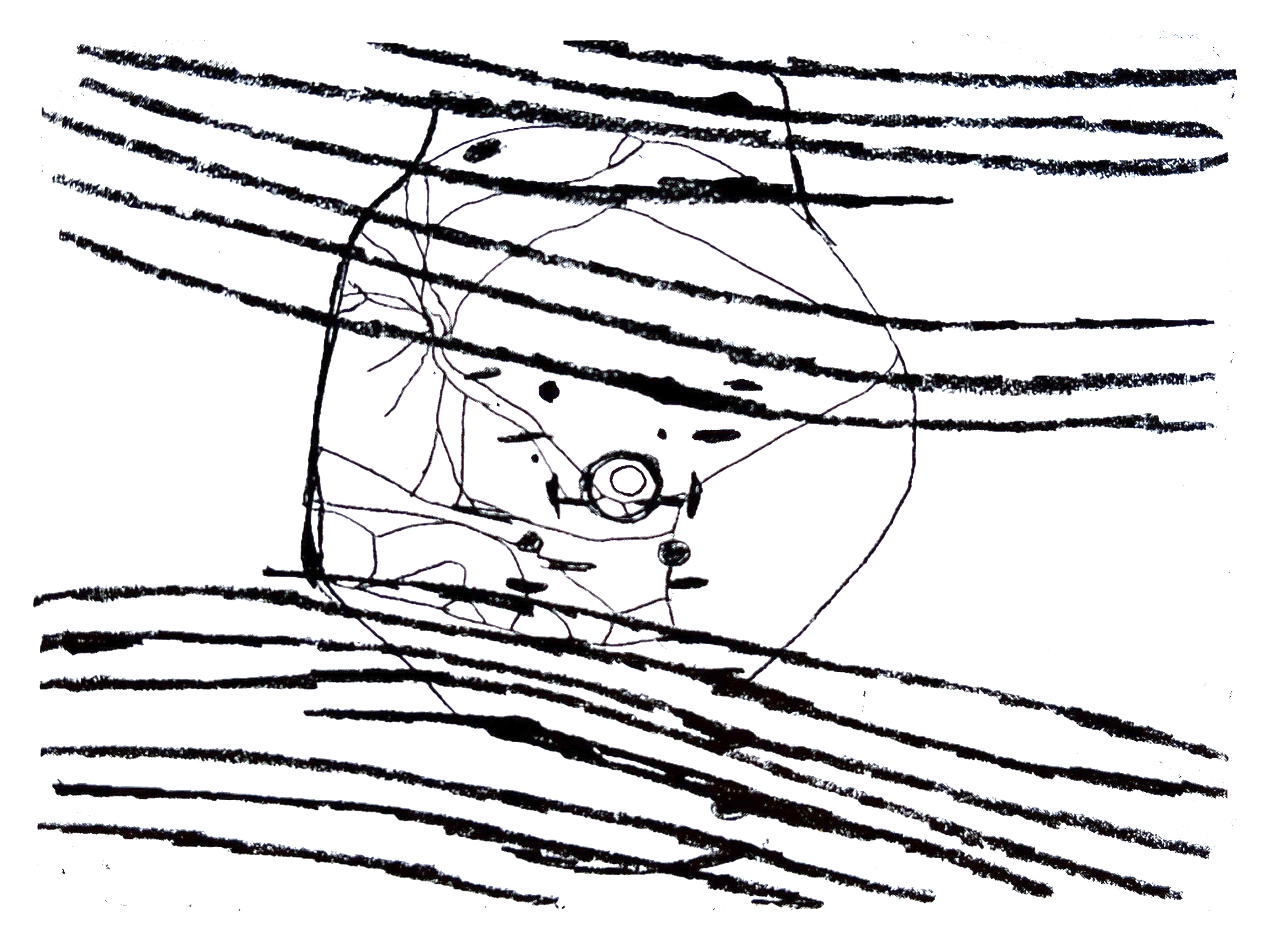
The drawing depicts a crystal (perhaps) from above, thin lines tracing the mind’s perception of the crystal’s edges. (Clark Coolidge would say a crystal is all edge.) The edges bend, yes, and their angles manifest dimension. I see the crystal forming off the paper, yet it remains flat. This flattening is due in part to the lack of shadow and the sketchy simplicity of the lines, but it’s also due to the overlaid lattice pressing the image back. This lattice is not a proper lattice, though. This lattice is more like a suggestion of parallel lines. A lattice entails perpendicularity: two sets, precisely opposed. The second set is missing here. Maybe we are zoomed in. Maybe it’s just the idea of a lattice, a movement toward it: the crystalline structure inside the object inflected over itself.
You only need to glance at Rita Evans’s crystalline and cellular drawings or briefly open Ximena Bedoya’s videos to see inflection upon inflection in this volume. (Of course, I encourage you to stay with the pieces a long while.) Something mechanical is happening in both collections—visually and sonically—but the mechanisms are turned, blurred, hummed into roving shapes like proteins with their own minds.
Winters uses the phrase “manual imagination” to describe his process: the work, indeed the line, is always in the form of a Deleuzean becoming. The hand makes the line at the same time as it forms in the mind: the line forms the mind. This is not a depiction of something previously imagined; it happens as it’s made. Shiff argues that the viewer participates in this too. This simultaneity—the manual imagination of making and experiencing—what we could rightly describe as vibration—is present in many of the contributions here.
Gabriella Moreno writes about Rilke and the ghostly—for Rilke primal—sounds produced from etched wax on phonograph cylinders. Vijay Khurana bends fragments of old family audio correspondences into strict poetic forms, phrases and verbal tics echoing across the poems. Yanina Spizzirri’s “Sound Figures Correspondences”—more correspondence, inflection—are minimalist ekphrastic poems in response to cymatic diagrams. Complementary, corresponding vibrations can be found in remnants from Katherine Smith’s Bridge Breathing 20:30 performance or Neiva Mulhern’s scores and sounds, where the field recordings that overlay still images cause the images to shimmer a little. Jessa Carta’s asemic insect paintings and sound piece offer something rhizomatic and corporeal—painted traces of animal body.
Winters’s 1995 mixed media version of Crystal Lattice is much more unsteady. This one is a negative of the first, with rough black charcoal scratches forming a ground behind the crystal, like a series of overlapping, refractive shadows. These two pieces make a vibratory pair, much like these works: in the artists’ own collections and across the volume: an imaginative and material resonance.
Kelly Krumrie